 Courtesy of Chad BarrettSave this storySave this story
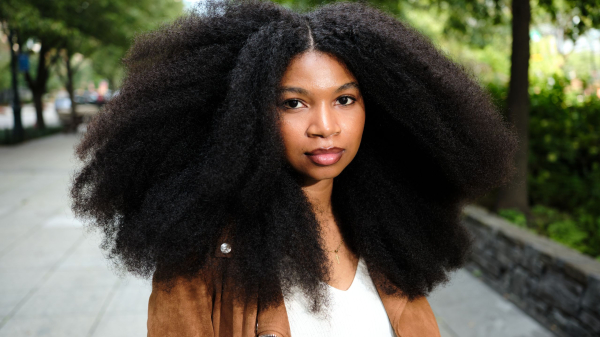
As someone who has long struggled to grow my 4C hair past my shoulders, long natural hair has always been aspirational. So, when one of my co-workers announced that the Guinness World Record for the biggest afro had been awarded, I scurried over to record holder Jessica Martinez‘s Instagram page. There, I found post after post featuring Martinez’s voluptuous curls, often brushed out into a poufy ‘fro that takes up the bulk of the frame. In real life, her afro measures 11.42 inches tall, 12.2 inches wide, and 6 feet, 2.87 inches in circumference—which is about the size of a large beach ball.
I couldn’t help but wonder: How’d she grow her hair so long? While my goal isn’t record-breaking length, I could definitely benefit from a few tips on how to grow and retain long healthy curls. A heart to heart with Martinez revealed that her approach, like that of many hairstylists, is to treat her scalp like a garden and her hair as its blooms: “It’s all about creating a good environment for hair to grow,” she tells me over Zoom.
 Courtesy of Karl Jean Baptiste
As simple as that sounds, there are still quite a few hurdles Black women face when trying to grow their hair—one of the main ones being the misconception that natural hair can’t grow long. Los Angeles-based hair colorist and co-founder of Highbrow Hippie Kadi Lee theorizes that this stigma exists because “the beauty industry doesn't show many examples of healthy, long natural hair, which quietly reinforces certain ideas about textured hair.”
South Carolina-based hairstylist Maya Smith says the way natural hair behaves also plays a role in this stigma. “Shrinkage [which refers to how tightly curls form] contributes to the illusion that our hair is short,” says Smith. “With un-manipulated hair, it’s often hard to get an accurate visual of someone’s actual length.”
Of course, external factors like heat and chemical damage play a role in how long your hair can grow. But in general, both stylists and Martinez agree that consistency and low manipulation are key in growing long natural hair. Ahead, the experts share their tips for growing your curls and coils while keeping as many inches as possible.
Know that protective styles don’t always equal protection
“A surprising amount of people seem to misuse protective styles,” says Smith. “Protective styling does not mean tuck it away and forget about your hair for the next three to six weeks.” Smith explains that your hair will absolutely dry out if you do this.
Keeping your style in for two months isn’t a crime, but be sure to moisturize and even cleanse your scalp if you can. Whitney Tolpinrud, MD, a board-certified dermatologist and Curology medical director suggests using an anti-fungal shampoo with ketoconazole, selenium sulfide, or zinc pyrithione, which help clarify the scalp. Mizani Scalp Care Anti-Dandruff Shampoo contains pyrithione zinc, plus peppermint oil and cucumber oil, which can be soothing. An apple cider vinegar cleanser like R+Co Lost Treasure Apple Cider Cleansing Rinse can also help clarify the scalp when you're wearing a protective style. Pharm to Table Scalp Relief Tea Tree Leave-In Conditioner and Camille Rose Mint Condition Spray contain tea tree oil, peppermint oil, and aloe which can help relieve itchy scalps.
I love braids as much as the next Black girl, but I have recently come to terms with the truth that braids aren’t the best protective style for me due to the tension they put on the scalp. “I often see individuals with textured hair struggle to grow it long because the hair has been over-manipulated with constant restyling, overuse of hot tools, and only giving their hair small breaks from protective styles,” says Lee. “This all creates unnecessary breakage.” Dr. Tolpinrud echoes this, adding that this sort of damage can lead to traction alopecia, which is hair loss caused by repeated pulling or tension on the hair, often from tight hairstyles worn over time.
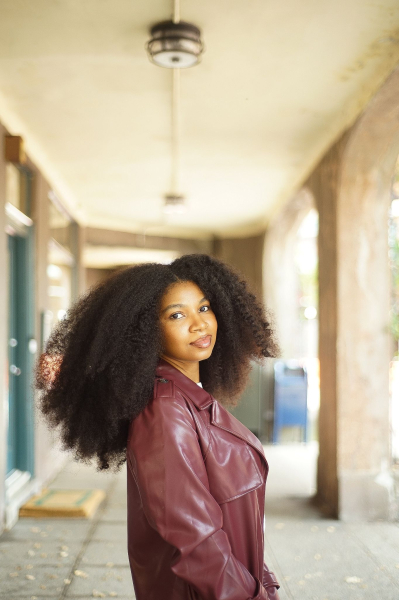
For Martinez, completely cutting out styles like box braids, wigs, and weaves was essential to her hair growth journey. “I limit my styles to super low-tension. I would even call them no-tension,” says Martinez. The content creator relies on styles like simple plaits (she puts her hair in two braids after each wash day), mini twists, the occasional half up half down style, and, of course, her signature afro.
Keep wash days simple
You’re less likely to be consistent with a routine that you don’t enjoy or can’t find time for—which is why Martinez simplified her routine. When first learning how to do her hair, Martinez recalls, it would take “forever.” “It took me many hours to do all the things. And then I decided to get rid of all the steps that I hate and just focus on the things that I need,” she says.
According to Lee, what every person with textured hair needs on wash day is a deep cleanse, a deep conditioning treatment, and a leave-in product. For her part, Martinez uses a prescription 2% ketoconazole shampoo for her seborrheic dermatitis, Aussie 3 Minutes Miracle Curls Detangling Deep Conditioner, Mielle Organics Kalahari Melon & Aloe Vera Deep Hydration 2-Minute Deep Conditioner, and Pattern Detangling Nectar. She washes her hair once a week, and she’s able to maintain that cadence because she doesn’t dread it.
Manage your expectations
Breakage is bound to happen from every day wear and tear—even to those with the most resilient strands. Martinez says she sometimes experiences a little breakage when she wears her hair in a half up half down style—at which point she doesn't “freak out about it.” “I'm not like, ‘Oh my God, I need this miracle hair product,’” says Martinez. “It's like, ‘No, okay, girl, maybe don't wear your hair like that for the next few weeks because you done messed up.’”
Many haircare brands market creams and oils that claim to grow hair and while some can help, they can’t replace the basics of a consistent, nourishing hair care routine, says Smith. Martinez warns against falling for the trap that any one product can grow your hair (especially if it claims it can do so quickly).
Part of Martinez’s hair growth journey has involved patience and making peace with the fact that even though her hair can break world records, it won’t always behave or grow the way she wants it to.